Design Strategy
How visual design decisions translate into competitive advantage and buyer confidence.
The Competitive Color Landscape
Every major Kastle competitor uses blue.
Verkada
Blue (#1E5EFF)
Brivo
Blue (#0057B8)
Avigilon Alta
Blue (#005CC5)
Kastle Systems
Red (#E2242A)
COMPETITIVE ADVANTAGE
When Kastle's website appears alongside Verkada or Brivo in a Google search result, an analyst comparison, or a trade show display — it is the only red result on the page. That distinctiveness is not a liability to correct. It is an asset to amplify. This design system was built around preserving and extending that advantage.
Brand Direction: Kastle Base
This prototype focuses on one direction: Brand Authority — the current Kastle identity, elevated. Brand red on white preserves the visual DNA of today's kastle.com while correcting its structural problems — missing CTAs, anonymous testimonials, form friction.
kastle-baseCurrent → ElevatedBrand Authority
The current identity, elevated.
For buyers who know Kastle, it feels immediately familiar. For new prospects, it reads as confident and established. As new brand materials are developed, the website updates cleanly — the three-layer token architecture means a color change, a new logo, or an updated type system propagates across every page and component without rebuilding anything.
Elevating the Brand
A website redesign is the ideal moment to evolve the brand itself. The website is the highest-traffic expression of the brand — every design decision made here ripples outward into sales collateral, trade show materials, product UI, and partner communications. Rather than treat the redesign as a cosmetic update to the existing identity, we see an opportunity to elevate Kastle's visual brand simultaneously — modernizing the mark, tightening the system, and creating assets that work harder across every channel.
The revised logo system below is one example of what this looks like in practice.
Revised Logo System
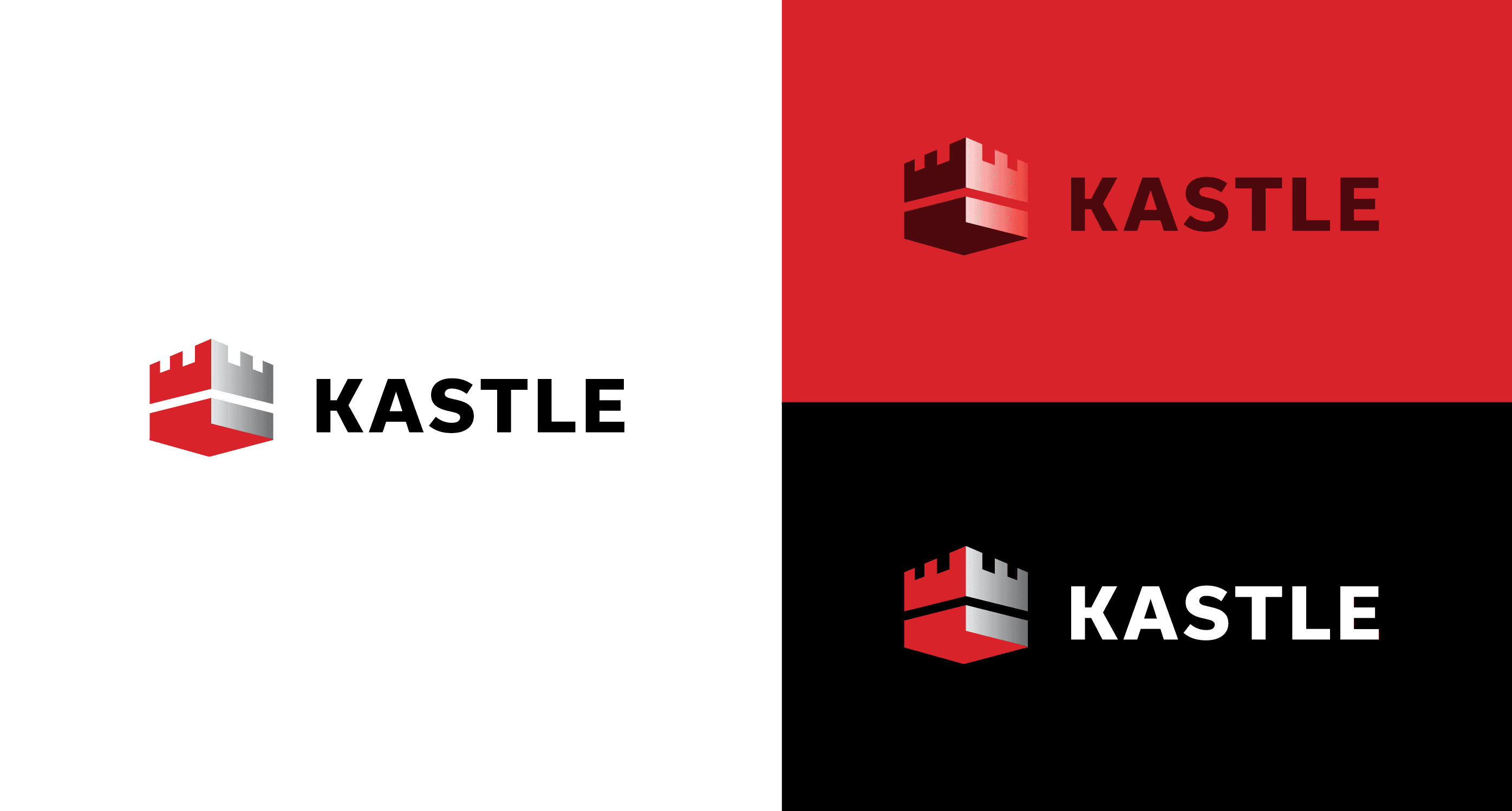
Light Mode
Primary usage on white and light surfaces — marketing pages, documentation, print collateral.
Brand Mode
High-impact placement on brand red surfaces — hero sections, event signage, social banners.
Dark Mode
Reversed for dark contexts — video overlays, dark UI, partner co-branding on dark backgrounds.
The updated castle mark retains Kastle's iconic identity while introducing dimensional depth that communicates solidity and modernity — qualities buyers expect from a 50-year security leader. The three-mode system ensures the brand works consistently across every context, from a white marketing page to a dark product dashboard. This is just the starting point — a full brand elevation engagement would extend to iconography, illustration style, photography direction, and motion language.
What Brand Elevation Includes
Beyond the logo, a simultaneous brand refresh during the website redesign can address:
Visual Identity
Logo system, icon library, illustration style, photography art direction
Brand Language
Tone of voice, messaging framework, tagline system, value proposition hierarchy
Design System
Color palette, typography, spacing, motion, component patterns — all tokenized for reuse
Color System
The color system is built on OKLCH, the perceptually uniform color space adopted by Tailwind CSS v4. OKLCH ensures that colors with the same lightness value actually appear equally bright to the human eye — something HSL cannot guarantee.
The brand red (#E2242A) anchored at step 500 generates an 11-step scale:
Token: --color-brand-{step} — see Foundations/Brand Colors for full WCAG contrast matrix
Semantic status colors complement the brand red without conflicting:
| Status | Light Surface | Default | Dark Text |
|---|---|---|---|
Success |
|
|
|
Warning |
|
|
|
Error |
|
|
|
Info |
|
|
|
Shifting to an AA-Compliant Brand Red
Kastle's current brand red (#D72329) passes WCAG AA contrast on white backgrounds (5.1:1) but falls short on black (4.2:1). For a brand that needs to work on dark hero overlays, dark-mode dashboards, and light marketing pages alike, that gap creates an accessibility liability.
We recommend a subtle shift to #E2242A — perceptually identical to the current red, but calibrated to pass AA on both white and black backgrounds simultaneously. The difference is invisible to the eye but measurable in compliance.
The shift from #D72329 to #E2242A is a 3% luminance adjustment — imperceptible in side-by-side comparison but the difference between a compliance gap and universal AA coverage. One CSS variable change propagates the update across every component in the system.
Typography
DM Sans is the primary typeface throughout the design system.
Why DM Sans
- Google Font — free, fast CDN delivery, zero licensing cost
- Geometric sans-serif with optical sizing (9–40pt)
- Weights 100–1000 — full range for the type scale
- Modern, clean character — reads as trustworthy and professional
- Excellent legibility at both small and large sizes
Type Scale
Full type scale specification: see Foundations / Typography
Why These Choices Win
Design decisions are not aesthetic preferences. They are business decisions with measurable outcomes.
Preserve brand red
Instant differentiation from all competitors in any media. No consumer research needed — Kastle customers already associate red with the brand.
DM Sans at all weights
A single typeface with full weight range creates visual hierarchy without font-loading overhead. Faster site = better Lighthouse score = better SEO.
5-field form maximum
Estimated 40–60% increase in form completion rate based on industry conversion benchmarks. The math: 13 fields → 5 fields = 8 fewer barriers.
Real testimonial attribution
Named testimonials convert 2–3x better than anonymous quotes in B2B contexts. Enterprise buyers want to know who else trusts the vendor.
Three-layer token architecture
Brand evolution is a CSS variable change, not a codebase rewrite. Any designer on Kastle's team can update brand colors without touching component code.
See It In Action
Design strategy made visible
Live Demo
Pages → Homepage
Interactive pages with real Kastle content and production components.
Color System
Foundations → Brand Colors
Full WCAG contrast matrix and semantic color roles.
Token Architecture
Foundations → Surfaces & Elevation
Three-layer token system: primitives, semantics, components.
Competitive Audit
Context → Competitive Landscape
Why every competitor chose blue — and why Kastle won't.